Twenty Bucks Here, Twenty Bucks There: How 'It's Nothing' Spending Eats a Grand a Year
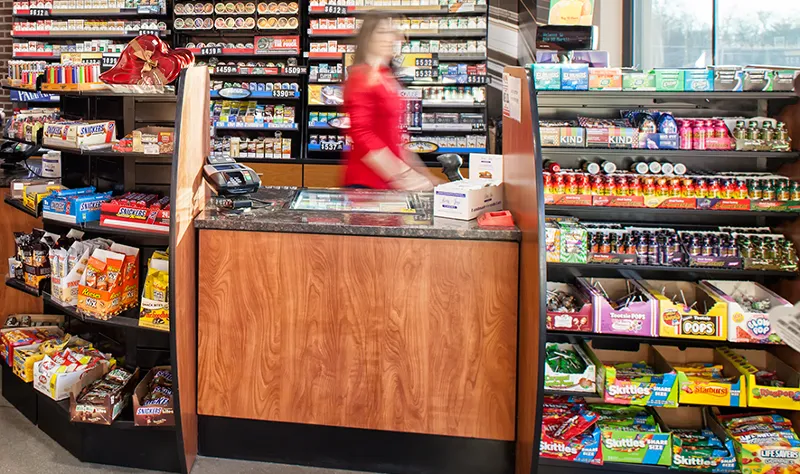
Photo: checkout counter impulse buys snacks candy convenience store, via cdn.informaconnect.com
There's a specific kind of math we all do at the checkout counter. The total comes to $18.42, and a little voice says: it's twenty bucks, relax. So you tap your card, grab the bag, and move on with your day.
The problem isn't any single purchase. It's that the voice shows up every single day, and it never asks to see a receipt from last time.
The 'Who Cares' Economy
Small purchases live in a psychological blind spot. Behavioral economists call it mental accounting — our brains file $17 impulse buys under 'rounding error' instead of 'spending.' Your rent gets a category. Your car payment gets a category. The scented candle you bought because the checkout line was long? That gets filed under nothing at all.
And that's exactly why it's dangerous. Nobody sits down at the end of the month and thinks, 'Man, I really went overboard on travel-sized Advil.' The purchases are individually invisible, which makes them collectively enormous.
Do the Math Once, Regret It Forever
Let's build a realistic profile of small-spending America. Not a worst case — just a normal week:
- Convenience store runs: a drink and a snack, three times a week, ~$9 a pop = $1,404/year
- App impulse buys: in-app purchases, a few $4.99 'deals,' mobile game extras = ~$180/year
- Amazon add-ons: the $12 thing you added to hit free shipping, twice a month = ~$288/year
- Checkout lane grabs: gum, a magazine, a candy bar, weekly = ~$260/year
- Random Target $18 items: you walked in for batteries = ~$936/year
That's north of $3,000 a year — and the conservative version of this list, where you only do half of it, still clears $1,500. Enough to fully fund a Roth IRA contribution for a young saver. Enough to cover a flights-and-hotel weekend in Nashville. Enough to be, well, a real number.
The 30-Day Receipt Audit
Here's the exercise, and fair warning: it stings.
For one month, don't change anything about your spending. Just track every purchase under $25. Use your banking app's transaction list, a notes file, whatever — the tool doesn't matter. What matters is that you'll see, in one column, thirty days of decisions your brain had been quietly deleting.
At the end, add it up and multiply by 12. Most people who do this describe the moment with the same word: sick. That's not a bad thing. That number doing its job is the whole point.
Give the Money a Name
Here's the trick that actually changes behavior: an unnamed savings goal is not a goal. 'Saving more' loses to a $14 protein shake every time, because 'saving more' has no face.
So name it. Open a separate high-yield savings account and title it something specific — 'Colorado Ski Trip,' 'Emergency Fund: Three Months,' 'The Down Payment.' Then set up an automatic transfer equal to your audit number, or even half of it. Every time you skip a convenience store run, you can mentally route that $9 to the account by name.
This works because it reframes the trade. You're no longer choosing between a snack and nothing — you're choosing between a snack and a lift ticket.
Three Rules That Do the Heavy Lifting
You don't need a budget spreadsheet with 47 tabs. Try these instead:
- The 24-hour cart rule. Anything under $25 that you didn't plan to buy sits in the cart for a day. Roughly 80% of the time, future-you deletes it.
- Never shop hungry, bored, or tipsy. These are the three states where the 'it's only twenty bucks' voice has full custody.
- Delete saved payment info from shopping apps. Adding friction — typing in a card number — kills a shocking number of impulse purchases on its own.
None of this means never buying anything fun. It means the fun stuff should be a decision, not a reflex. Twenty bucks is real money. It's just been really good at pretending it isn't.