The Paycheck Hiding in Your Pockets: What Nicotine Freedom Actually Pays, Month by Month

Photo: Noah Wulf, CC BY-SA 4.0, via Wikimedia Commons
We've written before about what a decade of cigarettes costs (spoiler: it's a new roof, a used car, or a very nice wedding). But framing it as a loss only works for some people. For others, the motivation has to run in the opposite direction: not what you're losing, but what you gain — in actual dollars, on an actual timeline.
So let's flip the script. If you quit nicotine today, when does the money show up? And how big does it get?
The Baseline: What You're Working With
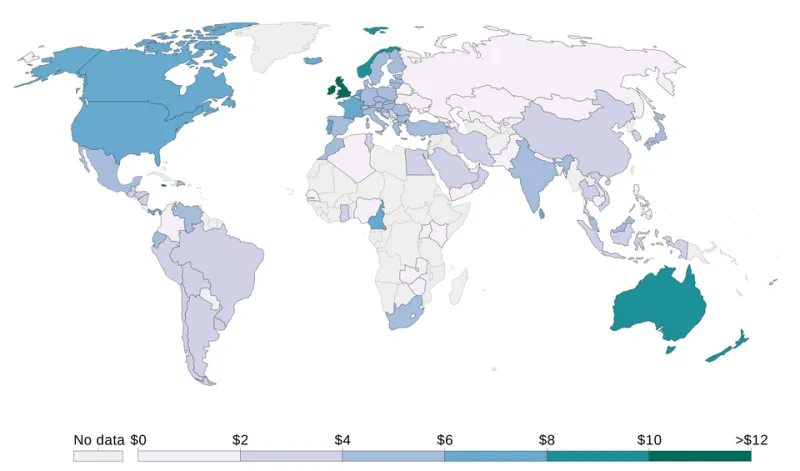
The average pack in the US now runs about $8 to $10 depending on your state — more in New York, less in Missouri, but let's use $9 as a round number. At half a pack a day, that's roughly $135 a month. A pack-a-day smoker? Call it $270 a month, or north of $3,200 a year.
That's not coffee money. That's a car payment. And unlike a car payment, it never ends — unless you end it.
Month 6: The Emergency Fund You Didn't Have
Six months after quitting, a half-pack quitter has banked around $810. A pack-a-day quitter is sitting on $1,620.
That's a real emergency fund. It's enough to cover a surprise car repair without a credit card, or a dentist visit you've been putting off. It's also, not coincidentally, the point where most quitters have beaten the worst of the physical cravings — so the money and the momentum arrive together.
Milestone reward idea: Take 10% of it and buy something you'd have felt guilty about before. You earned it. Literally.
Year 1: The Vacation Fund
One year in, and the half-pack quitter has $1,620. The pack-a-day quitter has $3,240.
That's a week in Cancun. A decent used laptop. A serious dent in a credit card balance. And here's the kicker most people miss: health and life insurance premiums often drop after you've been tobacco-free for 12 months, which means the savings start stacking on top of the savings.
Year 5: The Down Payment Zone
Now the math gets fun, because this is where compounding enters the chat.
If you'd been stuffing that cigarette money into an index fund earning an average 7% annual return instead of into a register drawer, here's where you'd stand at year five:
- Half-pack quitter: roughly $9,600
- Pack-a-day quitter: roughly $19,300
That's a down payment on a starter home in a lot of the country. In the Midwest, it might be the down payment. The average smoker who quits at 30 doesn't just save cigarette money — they save the interest, the fees, and the years of renting that the cigarette money could have replaced.
Year 10: The Six-Figure Runway
A decade of nicotine freedom, invested:
- Half-pack quitter: about $23,000
- Pack-a-day quitter: about $46,000
Half the pack-a-day quitters reading this are within striking distance of six figures in total financial impact once you factor in insurance savings, fewer sick days, and not replacing your coat every time you lean over a candle at a bar. That $46,000, left invested, keeps doubling roughly every ten years on its own. The cigarettes were never going to do that for you.
Year 20: The Retirement Boost
Twenty years out, the numbers stop feeling like "savings" and start feeling like "net worth":
- Half-pack quitter: roughly $70,000
- Pack-a-day quitter: roughly $140,000
Yes — a pack-a-day smoker who quits at 40 and redirects the money into a retirement account is looking at an extra $140,000 by 60, at average market returns. That's not a rounding error in a retirement plan. That's the difference between retiring at 65 and working until 70. That's a grandkid's college fund. That's the lake house timeshare you'd never actually recommend but would absolutely enjoy.
The Checkpoint System That Actually Works
Quitting is hard, and abstract decade-away rewards don't drag anyone through week three. So build your own milestone ladder:
- Day 30: First $270-ish saved. Transfer it somewhere you can see it. Watch the number.
- Month 6: Emergency fund territory. Small reward, guilt-free.
- Year 1: The insurance premium drop. Call your provider and ask — many reclassify you as a non-tobacco user after 12 months.
- Year 2: Book the trip. Seriously. Book it with the money.
- Year 5: Move the balance into an actual investment account if you haven't. A high-yield savings account is fine; the market is better.
- Year 10+: Recalculate. Nothing motivates like watching a number you built yourself.
The Habit You're Actually Buying
Here's the reframe worth sitting with: you were never just buying nicotine. You were buying a $140,000 hole in your future, one pack at a time, on an installment plan with no end date.
Quitting doesn't feel like a windfall on day one. It feels like a Tuesday. But every smoke-free day is a deposit, and the interest is the quietest, most loyal employee you'll ever have.
The smoke break you never took? It's still paying you — for the rest of your considerably longer life.